go-gui: A New GUI Framework for Go
04 Apr 2026go-gui is now in beta and ready for use.
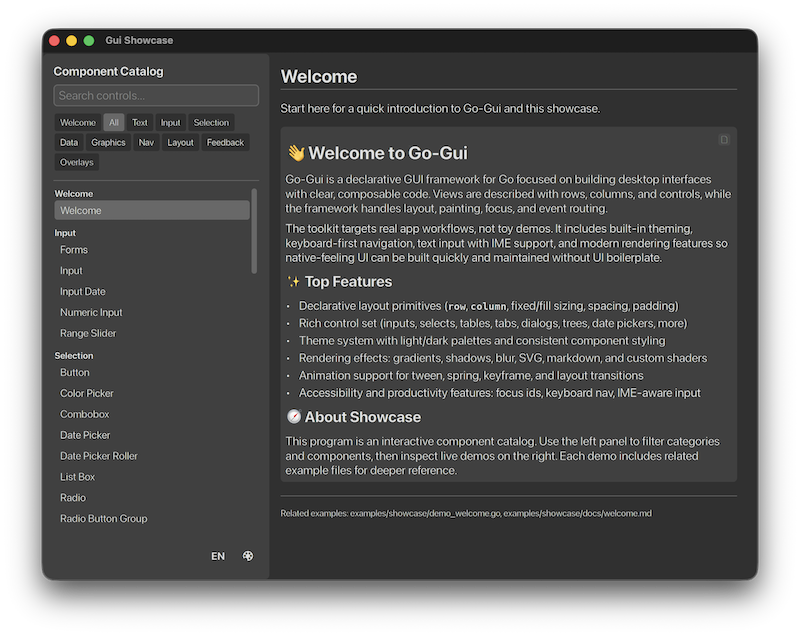
What it is
An immediate-mode GUI framework for Go. Every frame, a plain Go function returns a layout tree that gets sized, positioned, and rendered directly to the GPU. No virtual DOM. No diffing. No hidden magic. State lives in a single typed slot per window.
View fn → Layout tree → layoutArrange() → renderLayout() → []RenderCmd → GPU
Why it’s fast
- GPU-accelerated via SDL2 + Metal (macOS) and OpenGL (Linux/Windows)
- Web/WASM backend with WebGL shaders — runs in any browser
- iOS (Metal) and Android backends included
- No allocations per frame in the hot path
What’s included
50+ widgets — buttons, inputs, sliders, tables, trees, tabs, menus, dialogs, toasts, and more.
DataGrid with virtualization, sorting, grouping, inline editing, and CSV/TSV/XLSX/PDF export.
Dock layout with drag-and-drop panel rearrangement and tab groups.
Rich text — multiline input, Markdown and RTF views, syntax highlighting, SVG, bidirectional text via go-glyph.
Animation — keyframe, spring, tween, hero transitions.
Touch gestures — tap, double-tap, long-press, pan, swipe, pinch, rotate with automatic mouse synthesis.
Audio — opt-in via SDL_mixer; WAV, OGG, MP3, FLAC, MOD.
Why it’s easy to use
No callbacks, no bindings, no reactive machinery. The view function is called every frame. If your state changed, the UI reflects it. That’s it.
func view(win *gui.Window, s *State) gui.Widget {
    return gui.Column(
        gui.Text(fmt.Sprintf("Count: %d", s.Count)),
        gui.Button("Increment", func() { s.Count++ }),
    )
}
Beta status
The API is stabilizing. Core widgets and layout are solid. Expect minor breaking changes before 1.0.
Cross-platform support: macOS, Windows, Linux, iOS, Android, Web (WASM).
Requires Go 1.24+.
Source and examples: github.com/mike-ward/go-gui